
Penetrant Testing (PT) is used to detect casting, forging and welding surface defects such as hairline
cracks, surface porosity, leaks in new products, and fatigue cracks on in-service components.
PT is a nondestructive examination method used to locate surface breaking discontinuities in non-porous materials (metals, plastics, or ceramics). This method may be applied to ferrous and non-ferrous materials.
Penetrant Testing (PT).
Application
- Welds and weld overlays, castings and forgings, valves and their components, machined parts, pressure vessels, clad vessel linings, and structural steel.
- New fabrication weld inspection.
- Code compliant inspection.
- ASME Section V for pressure vessels.
- ASME B31.1 and B31.3 for piping.
- API 1104 for pipelines.
- In-service welds.
- Ferrous and non-ferrous components.
Advantages
- High visibility of indications.
- Low cost and fast results.
- Field Ready.
- Highly portable tools can be used in most locations.
- Can operate with battery power as well as supplied power when available.
Personnel Qualifications
Our inspectors are highly qualified, holding PT certifications at Level 2 in accordance with the SNT TC 1A certification scheme.
This qualification process ensures that our personnel possess the necessary knowledge, skills, and expertise to perform liquid penetrant testing.
Products
Equipped with following products:
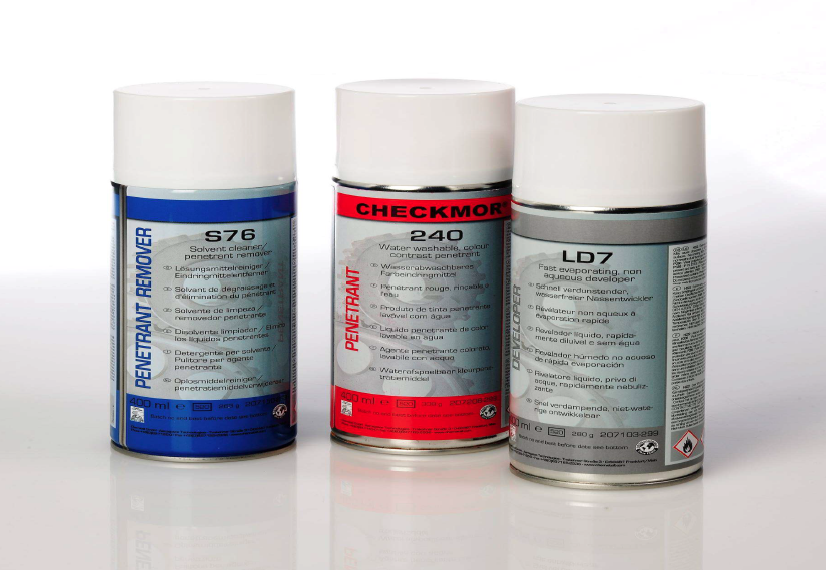
- Chemetall products: Penetrant (Checkmor 240), Developer (LD7) and Penetrant remover (S76).
- Srem products: Penetrant (Fluxo P172), Developer (FLUXO R175) and Penetrant remover (FLUXO S190).
- Accessories for cleaning and preparing the surface or piece for inspection, and clean up after carrying out test.