
inspections of materials and components. By electronically controlling multiple ultrasonic beams, PAUT
offers superior coverage and resolution for flaw detection and sizing. Its efficiency and accuracy make it a
cornerstone of non-destructive testing across industries, ensuring the integrity of critical assets.
Application
Welds and weld overlays, piping, pressure vessels, clad material, storage tanks and structural steel
This technique can be used during shutdowns, or on stream Complex geometries with a single probe.
Advantages
- High degree of repeatability. Position and size data for every flaw can be compared for repeat scans of the same area to track flaw growth or corrosion rates both generally and for individual pits.
- Inspecting a large portion of the component’s cross-section.
- The ultrasonic beam may be both steered (change of angle), focused and scanned without moving the probe.
- Portable, battery operated testing device
- Inspection can be performed on in-service equipment.
- Faster inspections and can be combined with TOFD scan.
Personnel Qualifications
Our inspectors are highly qualified, holding certifications at
Level 2 in accordance with the SNT TC 1A system. In both UT
and PAUT techniques.
This qualification process ensures that our personnel possess
the necessary knowledge, skills, and expertise to perform
phased array testing.
Equipment
Equipped with following equipment :
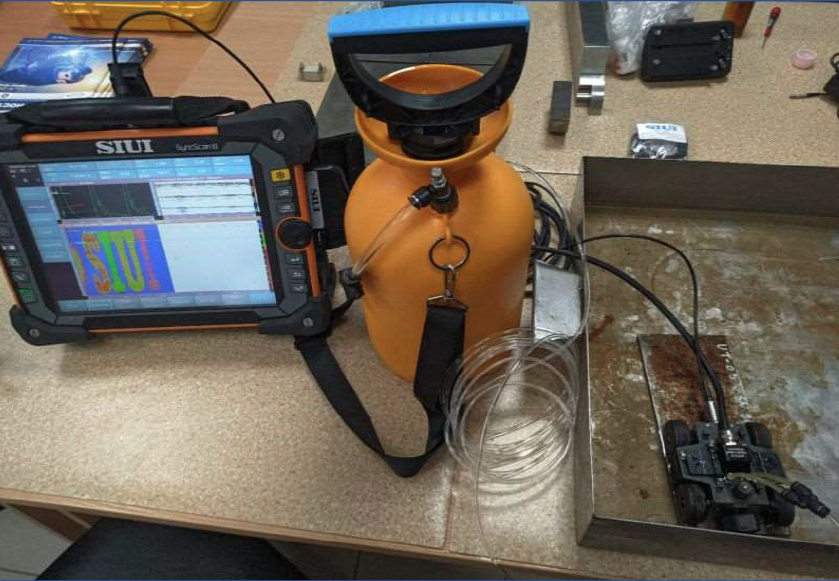
- SIUI SYNCSCAN 3 (64 :128 PR) (UT/PAUT/TOFD/TFM)
- SIUI probes and wedges collection for inspection of a large range of welding configuration and materiel including coarse grain material (stainless steel) with DLA probe.
- CPS 02A Chain scanner for PAUT and/or TOFD inspection
- PA Crawler for Corrosion Mapping MPS-01A
- Olympus EPOCH 1000i (UT/PAUT)
- Olympus probes and wedges collection for welding inspection and corrosion monitoring
- Calibration and validation blocs for different materials, application and thickness range