
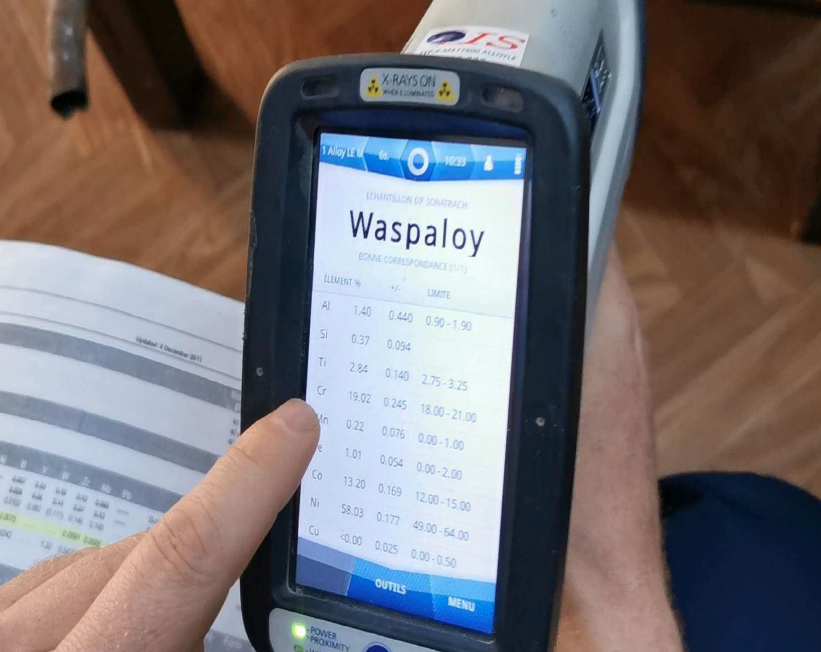
Positive Material Identification (PMI) is the analysis of a metallic alloy to establish composition by
reading the percentage quantities of its constituent elements.
The object of this nondestructive testing method is to identify metal alloys in place using a portable X-Ray fluorescent analyzer that determines the elemental composition of the material.
Positive Material Identification (PMI).
Application
- To test ferrous and non-ferrous metallic materials, stainless steels, Monels, Inconels, Hastelloys,
- Aluminum alloys, nickel based alloys, exotic materials.
- While verifying material compliance in power and petrochemical industries.
- To inspect valves and valve components, pipe, fittings, machined parts, castings, forgings, bolts and stock items.
- To inspect welds and weld overlays.
- To verify compliance of new and in-service pressure vessels, plate material, and structural steel.
Advantages
- Rapid and accurate analysis.
- Highly portable digital technology, can be used on site.
- Certifies components requiring NACE MR0175/ISO 15156.
- Leaves no trace of testing on test sample.
- Care must be taken to ensure that the surface of the test specimen is representative of the material as a whole.
- The instrument must be able to maintain surface contact with the material.
Personnel Qualifications
Our inspectors are qualified, holding certifications at visual inspection Level 2 in accordance with the SNT TC 1A system.
Equipment
- Equipped with Oxford X-MET5100 Hand-held XRF analyzer.
- Revolutionary Light Element analysis, no awkward vacuum pumps or helium bottles.
- Substantially faster analysis and throughput.
- Low detection limits: ppm level analysis in 10 seconds.
- Totally non-destructive testing.
- Traceable Empirical Calibration to certified reference materials.
- Fast and reliable identification of wide range of grades.
- Withstand temperatures up to 400ºC / 750ºF
- Analyze weld beams down to 2 mm with optional weld beam collimator.