Category Archives: Services

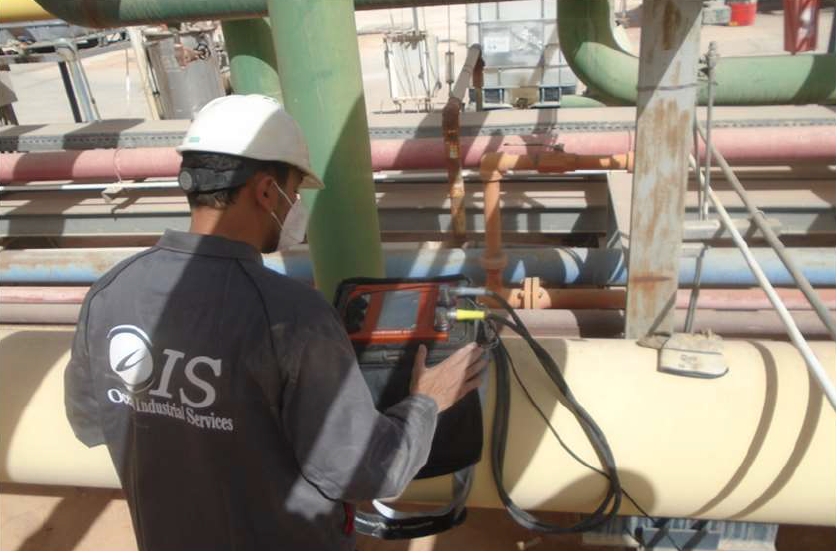
Long Range Ultrasonic Testing (LRUT/GWT)

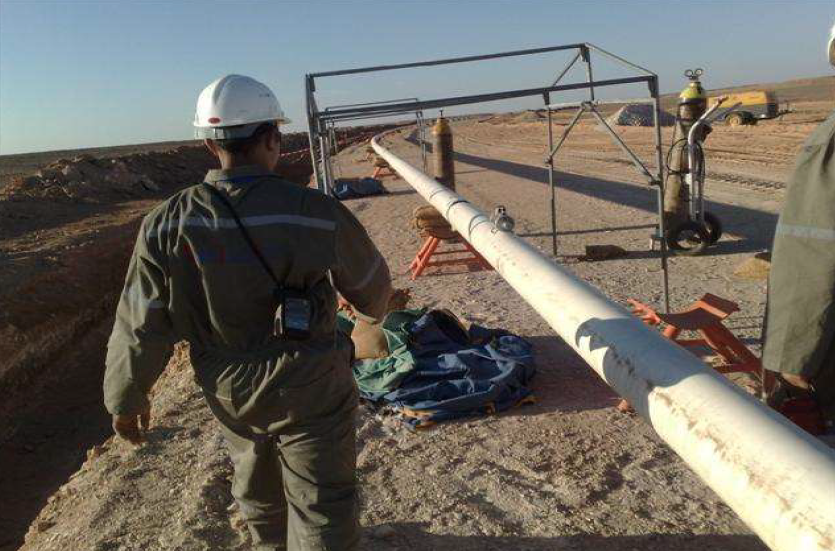
Guided wave ultrasonic testing detects corrosion damage and other defects over long distances in piping.
A special tool (transducer ring) is clamped around the pipe and transmits guided waves in both directions along the pipe.
Reflected signals from defects and pipe features such as welds are received by the transducer ring and sent to the main unit.

Application

  • Inspect sleeved road crossings.
  • Detect riser soil to air interface losses.
  • Detect corrosion under insulation.
  • Detect pipe rack support losses in-situ.
  • Inspect buried or insulated lines.
  • Difficult to access locations.


Advantages

  • Inspects difficult to access components without extensive excavation or insulation removal.
  • Portable, battery powered equipment.
  • Sophisticated software routines help identify and classify pipe signals.
  • Rigorous operator training and certification with individual electronic keys which activate the system and track its use by each operator.
  • Embedded reporting software allows the operator to analyze the results and produce a report on the spot.

Personnel Qualifications:

Our LRUT inspectors are highly qualified, holding GUL (Guided Ultrasonic Limited) certifications at Level 1 and 2 (pipeline and buried lines) and UT Level 2 in accordance with the SNT TC 1A system.

This qualification process ensures that our personnel possess the necessary knowledge, skills, and expertise to carry out LRUT inspection and interpret results.

Equipment:

Equipped with following equipment:

  • G4 mini 3 (designed for all pipe and tube applications).
  • GUL Solid rings 2” and 4”.
  • GUL Compact rings (6”/ 8”/ 10”/ 12”/ 14”/ 16”/ 18”/ 20”/24”) with 3 and 6 meters’ cables kit.
  • Wave reader (wavemaker) software for data interpretation and reporting.
Time of Flight Diffraction (TOFD)

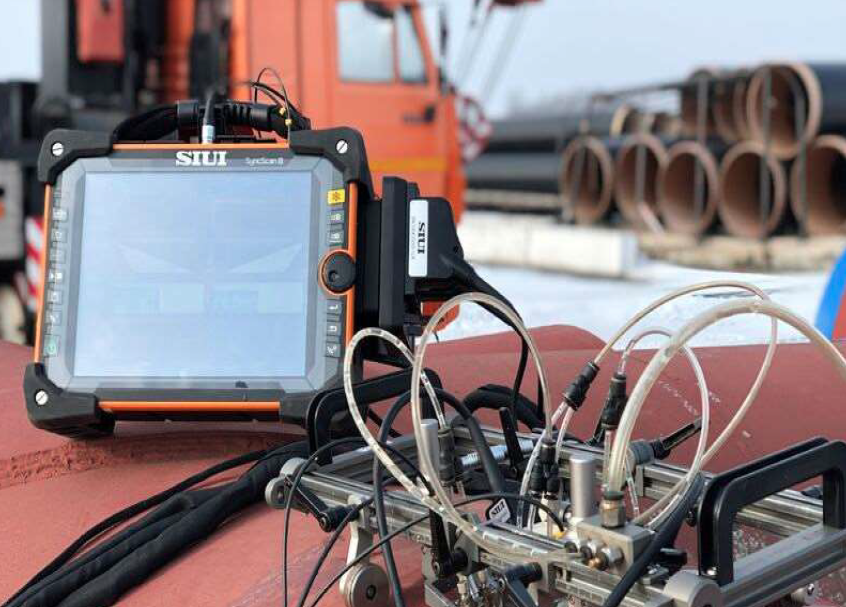
This ultrasonic inspection technique is commonly performed on welds and weld overlays, piping,
pressure vessels, clad material, storage tanks and structural steel. As fabricated heavy wall vessels and
piping can be thoroughly assessed for fabrication flaws with TOFD.
Application
To verify compliance with fabrication requirements for piping and vessels in accordance to standards such as:
  • ASME Section I, Code Case 189, or ASME VIII Division 1 and 2.
  • For in-service defect monitoring.
  • For detecting defects during the manufacturing process

Advantages

  • High degree of repeatability
  • Position and size data for every flaw can be compared for repeat scans of the same area to track flaw growth or corrosion rates both generally and for individual pits
  • Not limited by defect orientation
  • Precise defect sizing capability
  • Sensitive to all kinds of defects
  • Portable, battery operated testing device
  • On-line, volume inspection
  • Very fast scanning
  • Set-up independent of weld configuration
  • Amplitude insensitive, acoustical coupling less critical

Personnel Qualifications

Our inspectors are highly qualified, holding certifications at Level 2 in accordance with the SNT TC 1A system. In both UT and TOFD techniques.
This qualification process ensures that our personnel possess the necessary knowledge, skills, and expertise to perform TOFD testing.

Equipment

Equipped with following equipment :
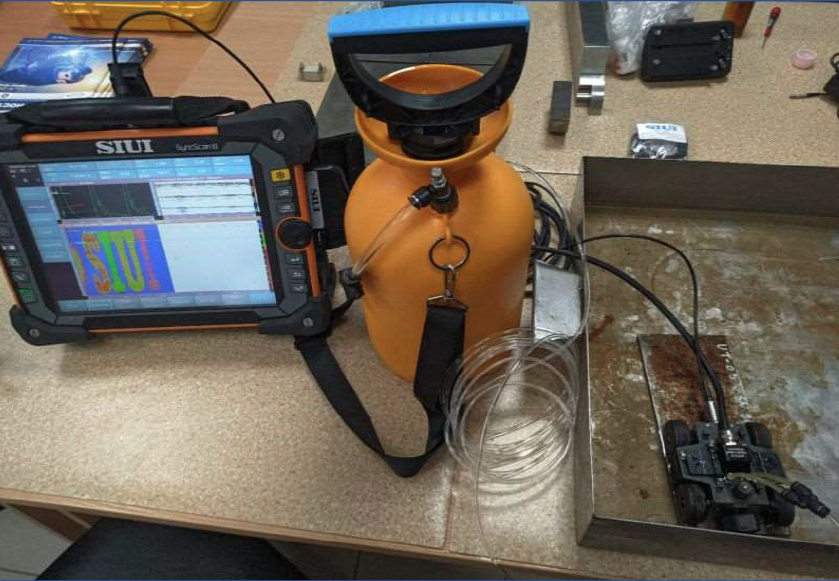
  • SIUI SYNCSCAN 3 (up to 04 TOFD channels)
  • SIUI probes and wedges collection for inspection of a large range of welding configuration and materiel.
  • CPS 02A Chain scanner for PAUT and/or TOFD inspection
  • Calibration and validation blocs for different materials, application and thickness range

Phased Array Ultrasonic Testing (PAUT/TFM)

inspections of materials and components. By electronically controlling multiple ultrasonic beams, PAUT
offers superior coverage and resolution for flaw detection and sizing. Its efficiency and accuracy make it a
cornerstone of non-destructive testing across industries, ensuring the integrity of critical assets.

Application

Welds and weld overlays, piping, pressure vessels, clad material, storage tanks and structural steel
This technique can be used during shutdowns, or on stream Complex geometries with a single probe.

Advantages

  • High degree of repeatability. Position and size data for every flaw can be compared for repeat scans of the same area to track flaw growth or corrosion rates both generally and for individual pits.
  • Inspecting a large portion of the component’s cross-section.
  • The ultrasonic beam may be both steered (change of angle), focused and scanned without moving the probe.
  • Portable, battery operated testing device
  • Inspection can be performed on in-service equipment.
  • Faster inspections and can be combined with TOFD scan.

Personnel Qualifications

Our inspectors are highly qualified, holding certifications at
Level 2 in accordance with the SNT TC 1A system. In both UT
and PAUT techniques.
This qualification process ensures that our personnel possess
the necessary knowledge, skills, and expertise to perform
phased array testing.

Equipment

Equipped with following equipment :
  • SIUI SYNCSCAN 3 (64 :128 PR) (UT/PAUT/TOFD/TFM)
  • SIUI probes and wedges collection for inspection of a large range of welding configuration and materiel including coarse grain material (stainless steel) with DLA probe.
  • CPS 02A Chain scanner for PAUT and/or TOFD inspection
  • PA Crawler for Corrosion Mapping MPS-01A
  • Olympus EPOCH 1000i (UT/PAUT)
  • Olympus probes and wedges collection for welding inspection and corrosion monitoring
  • Calibration and validation blocs for different materials, application and thickness range

Radiographic Testing (RT) / Radiography Profile (RP) Corrosion

Radiography is a nondestructive test method that utilizes electromagnetic energy (radiation) from Xrays or gamma rays in order to detect both surface and internal discontinuities. Radiography shadow shots can be used to inspect process piping, pressure vessels and valves, providing an easily viewed and permanent record of the component that has been inspected.

Application

For new fabrication weld inspection Efficient inspection of large volumes of components Code compliant inspection (ASME Section V, ASME VIII for pressure vessels, ASME B31.1 and B31.3 for piping, API 1104 for pipelines, and others) For In-service weld and material inspection. Often, we determine the extent of internal and/or external corrosion/erosion in process piping, Used for most metal and non-metal materials.

Advantages

Highly reproducible Data is stored for future comparison or audits Field ready Systems are portable and battery powered Light enough to easily take onto scaffolding Powerful setup tools to aid technicians in the field.

Personnel qualifications

Our radiographers and inspectors are highly qualified, holding certifications at Level 1 and Level 2 in accordance with the SNT TC 1A system. This qualification process ensures that our personnel possess the necessary knowledge, skills, and expertise to perform radiographic testing.

Equipment

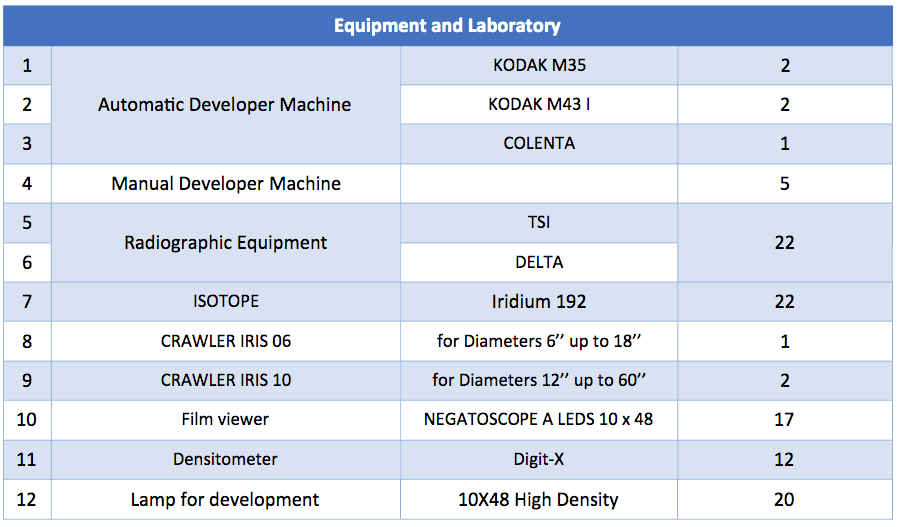
Equipped with various equipment, including X-ray generators, Gamma-ray TSI and DELTA for Iridium 192 isotope, Crawler IRIS 6 AND 120 for pipelines, radiation detectors, automatic film developing equipment, film viewers, densitometers and various accessories.

More details about equipment in the table below.